Welcome to our Learning Hub
Empower Your Curiosity
Insights, Stories, and Tips for the Inquisitive Mind
Our Story and Mission
Our journey began in the vibrant world of creative arts, a path that has not only shaped us as artists but as leaders, educators, and advocates. Through the arts, we discovered powerful skills — creativity, communication, resilience — that transcend the studio and stage, enriching our lives in education, business, and community leadership. Inspired by our own transformation, we're dedicated to unlocking this potential in others. Our mission is to guide individuals in exploring their creative talents, developing their personal and professional skills, and empowering them to lead and inspire in all aspects of their lives.
Our ethos is simple – everyone has a story to tell, a song to sing, or a dance to share. We believe in the transformative power of the arts to enrich lives and communities. By making arts accessible to all, we aim to foster confidence, creativity, and a sense of belonging.
So, dive in! Explore, learn, and let us know if there's something specific you're curious about. We're here to help, one post at a time.
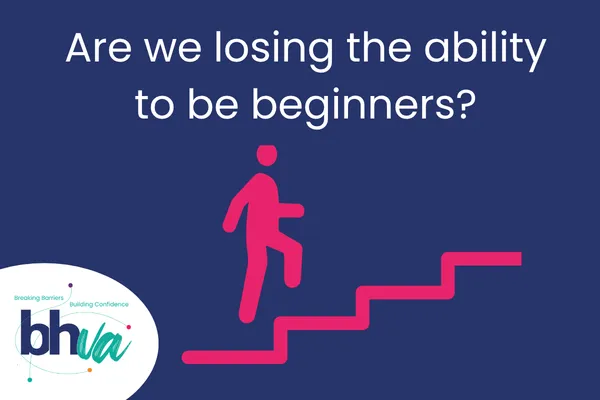
Are we losing the ability to be beginners
When children are little, we often encourage them to try new things.
Have a go.
See what happens.
You do not need to be good at it yet.
Just try.
But somewhere along the way, that changes.

As we get older, being new at something can start to feel uncomfortable.
We feel like we should already know what we are doing.
We feel like we should arrive with some skill.
We feel like we need to research it first, watch the videos, understand the basics, and make sure we do not look silly.
But what if that is the bit we are getting wrong?
What if being a beginner is not something to avoid
What if being a beginner is actually where the magic starts?
Why does being a beginner feel so hard?
We live in a world where everything feels instant.
You order something online and it can arrive the same day.
You search a question and the answer appears in seconds.
You scroll your phone and get quick little hits of entertainment, information and comparison.
So it makes sense that learning something slowly can feel strange.
Being a beginner does not always give us instant results.
It can feel awkward.
It can feel messy.
It can feel like everyone else knows what they are doing and you are the only one starting from scratch.
But most people are not as confident as they look.
They are just better at hiding the wobble.

And sometimes, all it takes is one person to say:
“I don’t know what I’m doing yet.”
Then suddenly, other people admit it too.
“Actually, I don’t either.”
“Same here.”
“I watched a YouTube video, but that probably doesn’t count.”
And just like that, the pressure drops.
The room changes.
People can breathe again.
Why we feel pressure to be good straight away
One of the biggest barriers to learning is the feeling that we should already be halfway there.
We see polished outcomes everywhere.
Finished performances.
Perfect artwork.
Confident speakers.
Successful businesses.
People who seem to know exactly what they are doing.
But we rarely see the first attempt.
The awkward start.

The bit where someone did not know where to stand, what to say, what brush to use, how to sing the note, or whether they were doing it right.
That part often gets hidden.
So we start to believe that being good is the starting point.
But it is not.
Being willing is the starting point.
Being curious is the starting point.
Being brave enough to say “I would like to try” is the starting point.
You do not have to be good at something to begin.
You begin so that you can learn.
What this means if you feel nervous to start
If there is something you have wanted to try, but you keep talking yourself out of it, you are not alone.
That might be singing.
Art.
Drama.
Music.
Speaking up.
Changing direction.
Trying something again after being told no.
The fear often sounds like:
“What if I am not good?”
“What if everyone else knows more?”
“What if I have left it too late?”
But those questions do not mean you should stop.
They usually mean you are standing at the beginning.
And beginnings are allowed to feel wobbly.
Why being a beginner can help you learn better
There is something really refreshing about working with someone who is completely new to something.

There are no habits to undo.
No fixed ideas.
No pressure to perform in a certain way.
Just a blank slate.
And that can be brilliant.
When someone steps into a room as a beginner, they often bring honesty with them.
They ask questions.
They experiment.
They notice things differently.
They are not trying to prove they already know.
They are there to explore.
That is where confidence can begin to grow.
Not through pretending.
Not through getting everything right.
But through trying something and discovering:
“Oh, I can learn this.”
“Oh, I enjoyed that.”
“Oh, I did not expect that to feel good.”
“Oh, maybe this is for me after all.”
Being a beginner is not empty.
It is full of possibility.
Learning something new is a journey, not a shortcut
We have talked before about the messy middle.
That stage where progress can feel slow, uncertain or uncomfortable.
But you cannot skip straight into the middle.
You have to start at the beginning.

And your beginning might look completely different to someone else’s.
That matters.
Because when we compare our start to someone else’s middle, we can easily feel behind.
We can feel like we are not good enough.
We can feel like we should already know more.
But learning does not work like that.
One person’s first step might be walking into the room.
Another person’s first step might be asking a question.
Another person’s first step might be singing one line, making one mark, trying one movement, or simply staying long enough to feel safe.
Those steps count.
They are not small because they look simple.
They are important because they begin the journey.
Is it ever too late to start something new?
One of the saddest things we hear is when someone says they were told they could not do something when they were younger.
They were told they could not sing.
They were not creative.
They were not confident.
They were not the right type of person.
And years later, that sentence is still sitting there.
Quietly stopping them.

But being told no once does not have to be the end of the story.
You are allowed to change your mind.
You are allowed to try something new at any age.
You are allowed to be a beginner as an adult.
And sometimes, starting later can be powerful.
Because you are not coming in to prove anything.
You are coming in because something in you still wants to try.
That matters.
What happens when someone feels safe to begin
Recently, someone came to us who had done something when they were younger, had been told they could not continue, and had carried that with them.
They did not come in saying they knew exactly what they wanted to be.
They did not arrive with a fixed plan.
They simply said, in their own way:
“I do not know what I can do yet. I just want to start again and try.”
And that honesty made the work possible.
There was no pressure to have all the answers.
No need to know the final destination.
Just a willingness to begin.
This is the difference a safe beginner space can make.
And that is often when the best learning happens.
Because when someone feels safe enough to be new, they can explore.
They can make discoveries.
They can find joy again.
They can realise that the door was not closed after all.
How being a beginner builds confidence
Confidence does not always come first.
Often, confidence comes after the experience.
After the first attempt.
After the support.
After the mistake that was not as scary as expected.
After the moment where someone realises they can keep going.
This is why beginner spaces matter.
Not just for children.
For young people.
For adults.
For creatives.
For businesses.
For anyone stepping into something new.
A good beginner space does not rush people to be impressive.
It gives them room to be curious.
It gives them permission to ask.
It gives them time to find their own way in.
Because confidence is not built by pretending to know.
It is built by feeling safe enough to learn.
What you can take from this

Being a beginner does not mean you are behind.
It means you are at the start.
And the start matters.
So if you or your child is trying something new, try to take the pressure off the outcome.
You do not need to know where it will lead.
You do not need to be brilliant straight away.
You do not need to compare your first step to someone else's tenth.
You only need enough curiosity to begin.
That is often where confidence starts.
Final thought: Go be a beginner
Being a beginner is not the problem.
It is not the bit to hide.
It is not the bit to rush past.
It is the start.
The blank page.
The open door.
The first note.
The first mark.
The first conversation.
The first small step into something new.
So if there is something you have wanted to try, this is your reminder:
You do not need to know everything first.
You do not need to be good before you begin.
You do not need to have the whole journey mapped out.
You can just start.
Go try something.
Go be a beginner.
In our latest vlog, we talk more about why being a beginner matters, and why start something new can be one of ht bravest parts of the journey.
Your Journey. Your Story.
Sign Up to BHVA Insights
Catch the latest on events, offers, and fresh ideas.
All delivered to your inbox every fortnight.







Beccy Hurrell Voice & Arts Limited is registered in England. Company No: 13263202. Registered office: 10 Kirby Street, Kettering, NN15 5GR